NACP certificates can be appealed in court even in the presence of criminal proceedings — CAS of the Supreme Court


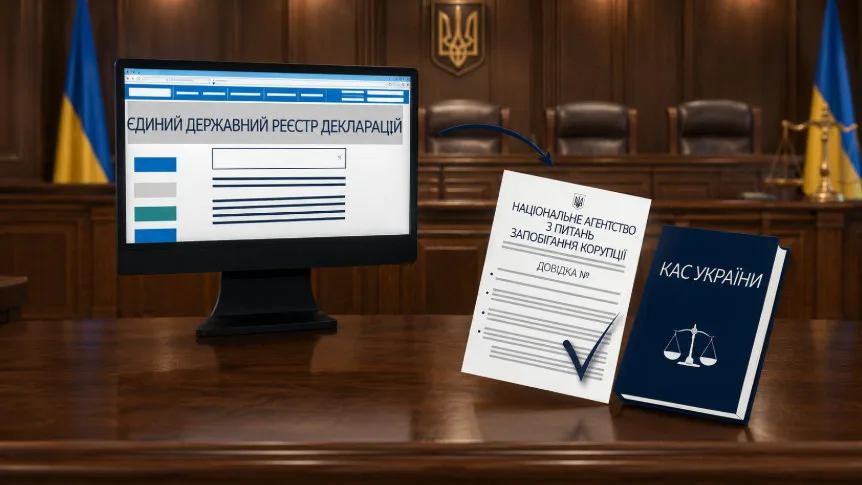










On July 3, 2026, the judicial chamber for cases concerning the electoral process and referendum, as well as the protection of citizens' political rights of the Cassation Administrative Court within the Supreme Court, adopted a ruling in case No. 420/3078/25, which clarified the legal approach regarding the right to appeal in administrative court proceedings the certificates of the National Agency on Corruption Prevention (NACP), drawn up based on the results of a full verification of declarations of declarants.
The subject of the cassation review was the issue of jurisdiction over the dispute in the claim to recognize as unlawful and cancel certain points of the NACP certificate, drawn up following a full verification of the annual declaration of a person authorized to perform state or local self-government functions. The appellate court closed the proceedings in the case on the grounds that after the initiation of criminal proceedings based on the facts stated in the certificate, such a certificate can no longer be an independent subject of appeal in administrative court proceedings.
The key question was whether an NACP certificate can be subject to judicial review in administrative court proceedings in the event that the NACP, following a full verification of the declaration, identifies signs of an administrative or criminal offense and subsequently takes measures to bring the declarant to legal responsibility.
In reviewing the case, the judicial chamber conducted a comprehensive analysis of the legal nature of the NACP certificate drawn up based on the results of the full verification of the declarant’s declaration and reached the following conclusions.
The judicial chamber confirmed the previously expressed position of the Supreme Court that a certificate drawn up by the NACP based on the results of a full verification of the declarant’s declaration is the result of the exercise of public authority management functions in the field of anti-corruption control and has the characteristics of an individual act within the meaning of paragraph 19 of part 1 of article 4 and paragraph 1 of part 1 of article 19 of the Code of Administrative Procedure of Ukraine (CAPU).
At the same time, the judicial chamber noted that such a certificate not only records the circumstances established during the verification but also generates independent legal consequences for the declarant. In particular, it creates the obligation for the declarant to submit a corrected declaration, serves as a basis for notifying the head of the body and specially authorized subjects in the field of anti-corruption, may be taken into account during disciplinary, personnel, and other administrative procedures, affect the business reputation of the person, and also be used as a source of information during other control procedures of the NACP.
The judicial chamber emphasized that the legal nature of the NACP certificate is primarily determined by the nature of the authority powers within which it was adopted, not by the subsequent use of its conclusions by other bodies. The fact of detecting signs of an administrative or criminal offense or the initiation of relevant proceedings does not change its legal nature and does not terminate the legal relations between the NACP and the declarant regarding its issuance.
Furthermore, the judicial chamber drew attention to the fact that the legislation distinguishes between the certificate on the results of the full verification of the declaration and documents drawn up to initiate bringing a person to legal responsibility. The certificate formalizes the results of the financial control measure, while the protocol on an administrative offense and the substantiated conclusion are drawn up to exercise the NACP’s powers related to responding to detected signs of offenses and initiating procedures to bring a person to legal responsibility.
The judicial chamber concluded that the initiation of criminal proceedings or proceedings in an administrative offense case does not eliminate the independent legal consequences of the NACP certificate and does not deprive the declarant of the right to appeal its legality in administrative court proceedings.
At the same time, the judicial chamber stressed that the scope of judicial review in an administrative court is to determine whether the actions (decisions) of the NACP were lawful in exercising public authority management functions and whether the certificate based on the results of the full verification of the declarant’s declaration meets the criteria of legality, reasonableness, proportionality, and procedural fairness in terms of the criteria defined in part 2 of article 2 of the CAPU.
The judicial chamber also noted that the simultaneous existence of administrative proceedings, proceedings in an administrative offense case, and criminal proceedings does not create competition of judicial jurisdictions, since within each of them different rights are protected and different legal issues are resolved. Depriving a person of the right to appeal an NACP certificate on the grounds of the existence of criminal proceedings or proceedings in an administrative offense case effectively excludes such an individual act from independent judicial control and undermines constitutional guarantees of the right to judicial protection and the rule of law principle.
In view of the above, the judicial chamber clarified the previously formed legal approach of the Supreme Court regarding the determination of administrative jurisdiction of such disputes and concluded that the initiation of criminal proceedings or proceedings in an administrative offense case related to the results of the NACP’s full verification of a person’s declaration and the issuance of the NACP certificate does not change the legal nature of such a certificate and does not deprive it of the status of an individual act of a public authority subject, and, considering part of the requirements of paragraph 1 of part 1 of article 19 of the CAPU, obliges administrative courts to exercise control over its legality as an administrative act of the NACP.
Applying these conclusions to the circumstances of the case, the judicial chamber stated that the appellate court unjustifiably concluded the absence of administrative jurisdiction over the dispute in the claim to recognize as unlawful and cancel certain points of the NACP certificate drawn up following the full verification of the annual declaration of a person authorized to perform state or local self-government functions and unlawfully closed the proceedings in the case. Therefore, the appellate court’s ruling was canceled, and the case was remanded to the appellate court for further consideration.
The ruling of the judicial chamber for cases concerning the electoral process and referendum, as well as the protection of citizens' political rights of the CAS of the Supreme Court dated July 3, 2026, in case No. 420/3078/25 (proceeding No. K/990/40384/25) can be viewed at this link.
Subscribe to our Telegram channel t.me/sudua and to Google News SUD.UA, as well as to our VIBER and WhatsApp, Facebook page and Instagram to stay informed about the most important events.