VRP Chronicles: The Third Disciplinary Chamber Closed the Case of Judge Hennadiy Salay and Reviewed a Marathon of Challenges in the Case of Judge Shevchuk












On June 17, 2026, the Third Disciplinary Chamber of the High Council of Justice reviewed the disciplinary case concerning Judge Hennadiy Anatoliyovych Salay of the Chernihiv Court of Appeal and decided to terminate the proceedings.
The complainant emphasized serious violations of the law by the judge when authorizing surveillance and wiretapping. The judge was accused of having, in 2018, as an investigative judge, considered and granted motions for covert investigative actions regarding judges of the Podilskyi District Court of Kyiv, despite violations of territorial jurisdiction rules.
Reporter Olga Popikova noted that according to the then-current version of Article 247 of the Criminal Procedure Code of Ukraine, in investigations involving judges, motions had to be submitted to the geographically closest appellate court. For Kyiv, this court is the Kyiv Regional Court of Appeal. However, law enforcement applied to the Chernihiv Court of Appeal allegedly due to a conflict of interest. The reporter considered that the consideration of the motion in Chernihiv violated territorial jurisdiction rules due to negligence and proposed to hold the judge disciplinarily liable in the form of a reprimand.
However, Judge Hennadiy Salay himself stressed that at that time there was a stable judicial practice that defined the choice of appellate court for authorizing covert investigative actions as discretionary powers of the prosecutor.
Previously, the disciplinary bodies of the High Council of Justice had already three times refused to open cases on similar complaints by lawyers regarding these procedural decisions, confirming the alleged absence of violations.
During the session, chamber member Dmytro Krupoderia proposed to refuse to hold the judge disciplinarily liable. The Disciplinary Chamber unanimously supported this proposal and terminated the proceedings (4 votes "for"). The complainant was also denied the transfer of the case for consideration by the High Council of Justice in full composition for review of this decision.
Recently, the High Council of Justice has been forming a punitive practice, consistently confirming at its meetings the possibility of dismissing a judge without a criminal conviction. Against the backdrop of recent decisions on the dismissal of judges, including Judge Vasyl Artymovych and Judge Pavlo Vovk solely based on covert investigative materials, the situation around Judge Hennadiy Salay's case appears as a precedent.
Dossier and Essence of Violations
Hennadiy Salay holds the position of judge at the Chernihiv Court of Appeal. His declarations over recent years show a stable high income (over 2.9 million UAH salary per year), ownership of several apartments, and updating his vehicle fleet with new cars.
However, the main claims against him concern procedural activity, namely violation of territorial jurisdiction: Hennadiy Salay authorized covert investigative actions based on motions from Kyiv pre-trial investigation bodies, which exceeded the jurisdiction of the Chernihiv Court of Appeal.
Despite the validity of the complaints, the Third Disciplinary Chamber of the High Council of Justice had already refused to hold Hennadiy Salay accountable. The reasons for this decision and the subsequent defense of the judge within the High Council of Justice have several aspects.
Civic activists publicly supported Hennadiy Salay, as his decisions, in their opinion, "greatly helped" in the fight against Pavlo Vovk. It was precisely thanks to the judge's authorizations that NABU obtained materials known as the "OASK tapes," which led to the exposure of a conspiracy within the court and its subsequent liquidation.
The High Council of Justice used the cases "Denysiuk v. Ukraine" and "Vikhor v. Ukraine" for in-depth analysis and justification of Hennadiy Salay, although in cases with other judges even covert investigative actions without a court verdict became an unconditional basis for dismissal.
More details about double standards and conflicts of interest in the High Council of Justice can be found in the previous article of the "Judicial and Legal Newspaper"
The Case of Valentyna Shevchuk
The second issue considered was the case of Judge Valentyna Shevchuk of the Zalishchyky District Court of Ternopil Region. Complaints were filed by the court chairman and the regional prosecutor's office.
The judge was accused of unlawful denial of access to justice, unjustified delay in case consideration, violation of self-recusal rules, and disrespectful attitude towards colleagues.
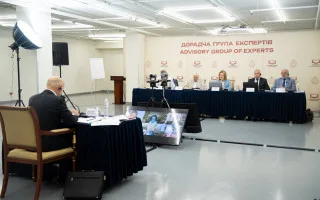
During the consideration of the case concerning Judge Valentyna Shevchuk, her defense filed a series of recusals against members of the High Council of Justice chamber, accusing them of bias and a prosecutorial inclination. In particular, presiding judge Oleksandr Sasevych was challenged for violating the right to defense by changing the procedural order and limiting speaking time. Oleh Kandziuba was accused of premature conclusions about the judge's guilt and superficial statements regarding the automated document management system (the defense argued in detail that errors in the system could not have been introduced by an external party and required reallocation of cases). Dmytro Lukyanov was challenged for similar solidarity with colleagues' positions.
The disciplinary inspector and the prosecutor's office called these statements an unjustified disagreement with the chamber's collegial procedural actions, after which the Third Disciplinary Chamber of the High Council of Justice unanimously rejected all three recusals.
The judge's defense tried to challenge the admissibility of audio recordings (anonymous conversations and judges' meetings), but the disciplinary chamber decided to evaluate them when issuing the final decision. A motion to summon complainant witnesses was also denied.
The inspector proposed dismissal from office. However, the chamber chose a "compromise" option: suspension from justice for three months with deprivation of bonuses, mandatory training at the National School of Judges, and subsequent qualification assessment.
The June 17 session demonstrated a deep split in the perception of the High Council of Justice's activities. On one hand, the chamber showed flexibility in Salay's case, recognizing the "prosecutor's discretion" as superior to formal territorial jurisdiction. This decision creates a precedent which, according to critics, may lead to legalization of procedural arbitrariness.
On the other hand, Judge Shevchuk's case demonstrated control over ethics and discipline in district courts. The different approach to appeals only reinforces suspicions of selective disciplinary practices. New lawsuits and appeals to law enforcement regarding the actions of High Council of Justice members can be expected soon.
Subscribe to our Telegram channel t.me/sudua and to Google News SUD.UA, as well as to our VIBER and WhatsApp, Facebook page and Instagram to stay informed about the most important events.