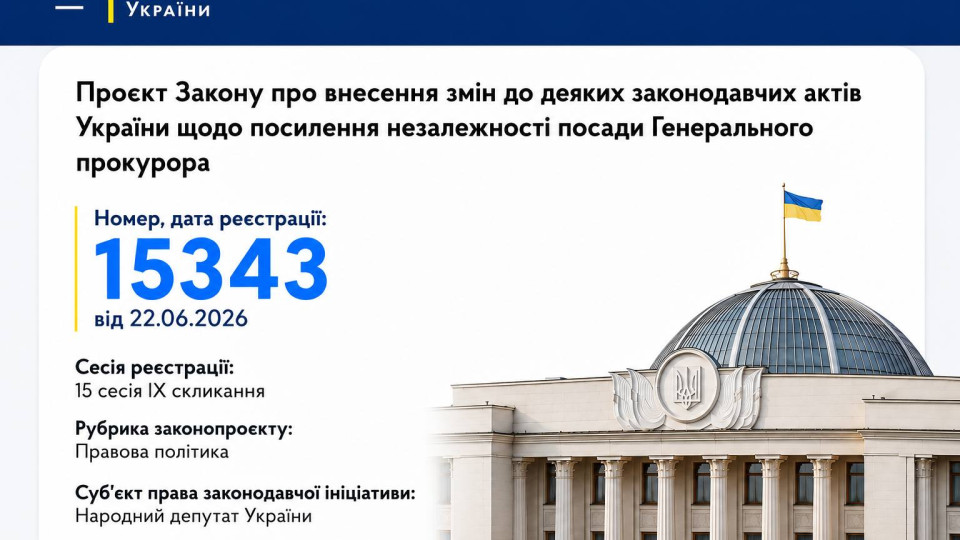
Bill 15343 Through the Prism of the Constitution of Ukraine: Analysis of Potential Constitutional and Legal Risks












The opening of the first negotiation cluster "Fundamentals" became a kind of Pandora's box for Ukraine, which, along with hope for EU membership, unleashed a series of controversial reform initiatives that increasingly raise questions about the limits of permissible changes in the constitutional architecture of the state.
The attempt to meet European benchmarks through Bill No. 15343 resembles a surgical operation with an axe: the noble goal of necessary depoliticization of the Office of the Prosecutor General is somehow implemented through mechanisms that conflict with the Constitution of Ukraine.
Read more about the proposed changes in the article Competition for the Position of Prosecutor General or Change of Constitutional Balance: What Risks Does Bill 15343 Contain
The draft Law "On Amendments to Certain Legislative Acts of Ukraine Regarding Strengthening the Independence of the Position of the Prosecutor General of Ukraine" proposes to introduce an open competition for the position of Prosecutor General, create a competition commission with the "decisive vote" of international experts, and transfer disciplinary proceedings regarding the Prosecutor General from the Qualification and Disciplinary Commission of Prosecutors (QDCP) to the High Council of Justice.
Below is a "constitutional crash test" of the bill: an analysis of its most vulnerable provisions that may not withstand verification for compliance with the Constitution of Ukraine.
The Role of the President as a "Technical Executor"
The focus is on a new provision of the bill that sets the framework for the head of state. The President is obliged within 10 working days to submit to the Verkhovna Rada a nomination for one of the two candidates for the position of Prosecutor General selected by the Competition Commission. If the parliament rejects the first candidate, the President submits the second. In case both candidates are rejected, the Competition Commission initiates a new selection round.
The President can effectively submit to parliament only candidates determined by the competition commission.
But do such innovations align with the Basic Law? According to paragraph 11 of part 1 of article 106 of the Constitution of Ukraine, it is the President who appoints and dismisses the Prosecutor General with the consent of the Verkhovna Rada.
The Constitutional Court of Ukraine has repeatedly emphasized in decisions No. 9-rp/2004 and No. 21-rp/2008 that the powers of the President of Ukraine are exhaustively defined by the Constitution of Ukraine. Therefore, the legislator is not entitled by adopting an ordinary law to grant the President new powers, change the content of existing ones, or establish a different procedure for their implementation if such a procedure directly follows from the Constitution. This approach is based on articles 8, 19, and 106 of the Constitution of Ukraine.
Moreover, in Decision No. 2-rp/2003, the CCU noted that if the Constitution fixes the name and method of appointment of the head of an organ, this guarantees the stability of its functioning, and changing the procedure by an ordinary law may lead to altering the constitutionally defined mechanism of power.
This approach fully correlates with European practice. In particular, in the well-known case Baka v. Hungary, the European Court of Human Rights pointed out that legal mechanisms that effectively deprive an official of the real possibility to perform a constitutional function may contradict the rule of law. Especially problematic are constructions that disproportionately narrow the space of constitutional discretion.
Considering this, the analyzed initiative falls into the zone of constitutional risk. The Constitution does not provide for a competition commission as a subject determining candidates, so the question arises about the limits of permissible legislative regulation of the relevant procedure. The Constitutional Court of Ukraine has repeatedly emphasized that the legislator is not entitled to change or narrow the scope of constitutionally defined powers of state authorities.
Thus, if the law effectively deprives the President of Ukraine of the possibility to independently exercise the constitutional power to determine a candidate or reduces his role to formal approval of another subject's decision, this may indicate a narrowing of the constitutional content of the relevant power and a violation of the constitutional balance of competence.
When a Parliamentary Commission Determines the Verkhovna Rada's Decision: Constitutional Risks of the Bill
Another controversial initiative of the bill concerns the procedure for expressing no confidence in the Prosecutor General. It is proposed to automatically exclude from the Verkhovna Rada's agenda the issue of no confidence in the Prosecutor General if the Temporary Investigative Commission (TIC) found no grounds or did not submit a report within the established deadline.
This construction also falls into the zone of potential constitutional risks. The fact is that article 89 of the Constitution of Ukraine clearly states: "Conclusions and proposals of temporary investigative commissions are not decisive for investigation and court." Furthermore, the conclusions of the TIC themselves are not acts of the Verkhovna Rada and are not equated with the official will of parliament unless otherwise follows from a decision adopted by the Verkhovna Rada in the prescribed manner.
This logic is consistently supported by the Constitutional Court of Ukraine. In particular, in decision No. 5-rp/2016, the Court stated that the purpose of the separation of powers is "the independent execution by each body of its functions and exercise of powers in accordance with the Constitution."
The Venice Commission in opinion CDL-AD(2010)040 also emphasizes the importance of clear procedures and the inadmissibility of mechanisms that indirectly block the exercise of constitutional powers. Auxiliary bodies should not replace the decisions of the representative body.
Thus, granting the TIC the right of veto over the constitutional power of the Verkhovna Rada (expressing no confidence in the Prosecutor General under article 85 of the Constitution) creates a risk of giving the TIC's conclusion a quasi-binding character, which may be regarded as an indirect restriction on the exercise of parliamentary power. The Constitution does not empower the TIC to block the Verkhovna Rada's exercise of its own constitutional functions.
How Artificially Raising the Stakes Devalues Parliamentary Control
The third controversial innovation of the bill is the attempt to raise the threshold for initiating the dismissal procedure of the head of the Office of the Prosecutor General. The authors propose to allow the inclusion of the no-confidence issue on the Verkhovna Rada's agenda only if supported by at least half (1/2) of the constitutional composition of deputies. Recall that the current norm requires only one-third (1/3) of votes to start the process.
From the standpoint of the Basic Law, this initiative looks doubtful, since paragraph 25 of part 1 of article 85 of the Constitution grants the Rada the power to express no confidence without establishing such high entry barriers at the level of ordinary law.
Note that the Venice Commission in Report CDL-AD(2010)040 states that although parliamentary accountability is important, establishing an exhaustive list of grounds for political no confidence nullifies the very essence of this instrument.
Changing the procedural threshold for initiation may affect the effectiveness of the parliament's control function but belongs to the sphere of procedural autonomy and requires assessment for proportionality.
Expansion of the High Council of Justice Beyond Its Powers
Another novelty from the bill's authors is the attempt to grant the High Council of Justice the power to conduct disciplinary proceedings regarding the Prosecutor General at first instance.
Does the Basic Law allow such an expansion of powers? Article 131 of the Constitution of Ukraine contains a list of what the HCJ should do. Paragraph 3 of this article assigns the Council to consider complaints against already adopted decisions of the relevant body on bringing prosecutors to disciplinary responsibility.
This position is confirmed by the practice of the Constitutional Court of Ukraine. In Decision No. 4-r/2020, the Court emphasized that the High Council of Justice is a constitutional body of judicial governance aimed at ensuring the independence of the judiciary. At the same time, after the 2016 constitutional reform, the prosecution was finally separated as an independent constitutional institution. Under such circumstances, granting the HCJ decisive powers regarding the appointment or disciplinary responsibility of the Prosecutor General may raise questions about the compliance of such a model with the constitutional architecture of the distribution of powers among state authorities.
The European Court of Human Rights in the case Oleksandr Volkov v. Ukraine established that combining the functions of review and decision-making in one body without proper role separation violates article 6 of the Convention.
Moreover, the Venice Commission (CDL-AD(2010)040) also stresses that if judicial and prosecutorial governance bodies are combined, it must be guaranteed that judges and prosecutors cannot influence each other's disciplinary cases.
That is why the attempt to rewrite the functions of the HCJ by ordinary law becomes a potential norm for challenge in the Constitutional Court. Transforming the HCJ from an appellate instance into a "prosecutorial governance" body without amending article 131 of the Constitution may be grounds for constitutional challenge. The Constitution does not explicitly provide the HCJ with personnel or disciplinary governance functions regarding the Prosecutor General.
Transferring first-instance functions regarding the Prosecutor General to the HCJ without constitutional amendments may be challenged as exceeding the constitutional model since the HCJ by its nature is a judicial governance body, not a universal disciplinary center for the prosecution.
Legal Uncertainty and the "Personnel Corridor"
In an effort to prevent prolonged tenure of acting heads, the bill's authors propose a limitation: the acting duties of the Prosecutor General by the first deputy cannot exceed six months. At the same time, the bill leaves unresolved the legal consequences of the expiration of the six-month term of acting duties and does not establish separate procedural deadlines for conducting competition procedures.
According to article 8 of the Constitution of Ukraine, the principle of the rule of law is recognized and operates in Ukraine, an integral part of which is the predictability of legislation.
The Constitutional Court of Ukraine consistently emphasizes this, particularly in Decision No. 7-r/2020, where the Court stressed that legal certainty requires clarity and predictability of legal consequences.
Similar requirements for the "quality of law" are set by European institutions. In the case "Novik v. Ukraine", the European Court of Human Rights reminded that the principle of legal certainty is part of the quality of law requirement. The law must be sufficiently accessible, clearly formulated, and predictable in application to exclude any risk of arbitrariness.
Furthermore, in the case "Oleksandr Volkov v. Ukraine", the ECHR additionally emphasized that lack of clarity in procedural norms concerning the status of judges (and prosecutors as part of the justice system) creates a threat to legal certainty and can be used as a tool of pressure. The Venice Commission also insists that criteria of professional ethics and procedural deadlines must be detailed in the law to ensure predictability of consequences.
The proposed provision effectively creates a risk for the continuity of the prosecution bodies' functioning. It is enough to model a quite realistic situation: the competition procedure is blocked — for example, due to lack of votes — and the six-month term of acting duties of the Prosecutor General has already expired. In such a case, normative uncertainty arises about who and on what legal basis is authorized to perform key procedural actions. Such changes can significantly complicate the functioning of the prosecution system and create legal uncertainty regarding the exercise of certain powers of the Prosecutor General.
Establishing a six-month term for acting duties without guarantees of completing the appointment procedure creates a risk of violating the principle of legal certainty due to the absence of a completed procedure in case of non-appointment of the Prosecutor General.
Legal Uncertainty and the "Personnel Corridor"
The draft proposes to transfer the function of selecting candidates to the Competition Commission, whose decisions become imperative (mandatory) for the head of state.
According to paragraph 11 of part 1 of article 106 of the Constitution, the President appoints the Prosecutor General with the consent of the Rada. Involvement of a competition commission in the procedure is not provided for by the Constitution.
The Constitutional Court of Ukraine has also drawn attention to the danger of such legislative changes. In its practice, the Court has repeatedly emphasized that the legislator is not entitled to change the constitutional content of the powers of state authorities or effectively transform the Constitution-established model of their functioning by adopting an ordinary law. Such changes can only be made by amending the Constitution of Ukraine. Moreover, in Decision No. 7-r/2020, the Constitutional Court stressed that the principle of the rule of law requires sufficient clarity, predictability, and stability of legal regulation, and citizens and state institutions must have a clear understanding of the legal consequences of applying the law.
In Decision No. 4-r/2020, the Constitutional Court indicated that state bodies must function without mixing competences. Narrowing the discretion of the Head of State by ordinary law contradicts part 2 of article 106 of the Constitution, which does not provide for delegation of presidential powers to other bodies; therefore, the law cannot effectively redistribute them beyond the Basic Law.
According to the Venice Commission report CDL-AD(2010)040, the model of prosecution in each state must reflect its specific legal culture and be consistent with the constitutional architecture. The Commission emphasizes that although European standards allow for diverse models, any reform cannot replace the mechanism defined by the Constitution with another not provided for by the Basic Law.
The problem is not the existence of a competition commission as such or the participation of international experts. The constitutional risk arises when the commission's recommendation effectively becomes a mandatory verdict that determines the exercise of the constitutional powers of the President and the Verkhovna Rada. The imperativeness of the competition body's decisions can significantly affect the balance between constitutionally defined appointing subjects and the actual mechanism of candidate selection.
Does Bill No. 15343 Become a Hidden Constitutional Reform?
The proposed changes effectively alter the balance of powers between the President, Parliament, and the High Council of Justice. However, article 157 of the Constitution explicitly prohibits making any amendments to the Basic Law during martial law.
Paragraph 14 of part one of article 92 of the Constitution of Ukraine authorizes the Verkhovna Rada to determine by law the organization and activities of the prosecution. At the same time, this power cannot be interpreted as allowing changes to the constitutional distribution of powers among state authorities or establishing a different procedure for exercising powers directly defined by the Constitution of Ukraine.
The exercise of powers regarding changes in the organization of the prosecution, including the appointment of the Prosecutor General, must be carried out in connection with articles 6, 8, 19, 106, 131, and 131-1 of the Constitution of Ukraine. The law may detail procedures but is not entitled to change the constitutionally defined distribution of powers between the President of Ukraine, the Verkhovna Rada of Ukraine, and other constitutional bodies or narrow the discretion of the head of state directly enshrined in paragraph 11 of part one of article 106 of the Basic Law.
The Venice Commission in its opinions has consistently indicated that constitutional reforms should not be "hostages of short-term political calculations" and must occur exclusively through transparent procedures. Any initiative aimed at circumventing constitutional guarantees through ad hoc legislation, according to the ECHR practice (case Baka v. Hungary), is recognized as contradicting the rule of law.
Formally, article 157 of the Constitution of Ukraine prohibits amendments to the Basic Law during martial or emergency state. At the same time, this prohibition does not extend to the adoption of ordinary laws. However, this does not mean that the legislator can change the constitutionally defined distribution of powers or effectively transform the model of state authority organization by ordinary law. The law may detail the procedure for implementing constitutional norms but only within the limits defined by the Constitution itself.
European Choice: Does the Bill Comply with EU Standards?
The proposed reform model of the Office of the Prosecutor General, despite the declared goal, contains a number of provisions that may be subject to constitutional and legal dispute regarding the limits of permissible regulation without constitutional amendments. The main problem lies in the attempt to change the practical balance of constitutional powers through ordinary law without amending the Constitution of Ukraine.
The bill's authors emphasize that it is worth changing the model of selecting candidates for the position of Prosecutor General, in particular to choose not only people whose contacts are already in politicians' notebooks, who actually select prosecutors. Essentially, the project proposes to change the procedure so that candidates will be selected simply from other notebooks.
The authors also note that the experience of competitive selection of prosecutors is widespread in Europe, in particular, in Latvia, the Prosecutor General is selected by an independent justice council through competition.
The authors' reference to the experience of the Republic of Latvia itself cannot indicate the constitutionality of the proposed model. The constitutional status of the prosecution, the powers of the President, parliament, and judicial governance bodies in each state are determined by its own Constitution. Therefore, comparative legal analysis can only be used as an auxiliary argument but not as an independent justification for compliance with the Ukrainian Constitution.
The authors stress the need to meet European benchmarks, but their arguments raise questions.
So is the new project an EU requirement or a free interpretation? The key thesis of the initiators is that the EU requires exactly a competition procedure. However, according to Andriy Levkovets, this is not true. The European Union indeed pointed to the need to review the procedure for appointing the Prosecutor General but did not specify that it must be a competition. Moreover, it insisted that this review be conducted with the involvement of the Venice Commission. At the time of analysis, there is no public information that the bill was sent to the Venice Commission for an official opinion. This raises serious doubts about its compliance with the best European practices.
Reform is needed, but it must occur through strengthening the role of professional self-governance and advisory opinions, not through destroying the system of checks and balances enshrined in the Basic Law. Potential recognition of this law as unconstitutional in the future will cause much greater harm to European integration than careful revision of the draft now.
Bill No. 15343 cannot be unequivocally assessed as contradicting the Constitution of Ukraine. At the same time, some of its provisions contain significant constitutional and legal risks related to possible narrowing of the discretionary powers of the President of Ukraine, expansion of the competence of the High Council of Justice beyond its constitutional status, and insufficient clarity of certain procedures. If the law is adopted, these provisions may become the subject of constitutional review.
Author: Volodymyr Pravo
Subscribe to our Telegram channel t.me/sudua and to Google News SUD.UA, as well as to our VIBER and WhatsApp, page on Facebook and on Instagram to stay informed about the most important events.