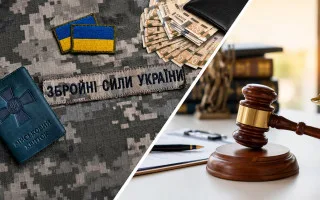
The National Guard demanded that the mother of a deceased serviceman prove that her son did not commit suicide — the court recognized this as illegal













The Kyiv District Administrative Court recognized the actions of the Main Directorate of the National Guard of Ukraine as unlawful, which returned the documents for the appointment of a one-time financial aid to the mother of the deceased serviceman due to the absence, among other things, of a document that should have confirmed that the death did not result from suicide or intentional self-inflicted bodily harm.
The court emphasized that the legislation does not provide for the existence of such a document and does not impose on the family members of the deceased the obligation to prove the absence of grounds for refusal of payment. Furthermore, the court concluded that the Main Directorate of the National Guard was not authorized to independently return the applicant’s documents but had to act in accordance with the procedure defined by Cabinet of Ministers Resolution No. 975.
Circumstances of the case
The plaintiff was the mother of a chief sergeant of the National Guard of Ukraine who died in September 2022 while serving in the military. The military medical commission established that the fatal injury was caused by an accident related to military service. The order removing the serviceman from the personnel lists also stated that the death occurred during military service.
In September 2024, the woman submitted an application through the military unit to the Main Directorate of the National Guard of Ukraine for the appointment of a one-time financial aid provided for by Article 16 of the Law "On Social and Legal Protection of Servicemen and Their Families" along with the necessary documents.
However, the Main Directorate of the National Guard returned the documents by letter, citing their incompleteness. In particular, the applicant was pointed to the absence of documents disproving the fact of intentional self-inflicted bodily harm or suicide by the serviceman, as well as an extract from the information-analytical system regarding the applicant’s criminal liability and criminal record. After correcting these deficiencies, she was invited to resubmit the documents.
Disagreeing with these actions, the woman appealed to the court. She stated that Procedure No. 975 does not authorize the Main Directorate of the National Guard to independently return documents to the applicant. In her opinion, the defendant should have acted according to the procedure defined by Procedure No. 975, and the final decision on the appointment or refusal of assistance in this case should be made by the Ministry of Defense of Ukraine.
What the court established
The court emphasized that the subject of the dispute was not the mother’s right to receive one-time financial aid, but the legality of the actions of the Main Directorate of the National Guard of Ukraine regarding the return of documents without further processing in accordance with the procedure defined by Cabinet of Ministers Resolution No. 975.
After analyzing the Law "On Social and Legal Protection of Servicemen and Their Families" and Procedure No. 975, the court concluded that the Main Directorate of the National Guard was not empowered to independently return the applicant’s documents. It was required to reconsider the submitted materials, make an appropriate conclusion, and act according to Procedure No. 975. In this case, the decision on the appointment or refusal of one-time financial aid must be made by the Ministry of Defense of Ukraine.
The court also noted that the military medical commission established a causal link between the death and military service and determined that the death resulted from an accident. According to the court’s conclusion, this does not align with the assumption of intentional self-harm or suicide by the serviceman. At the same time, questions regarding the presence or absence of criminal or administrative offenses in his actions fall within the competence of other authorized bodies, not the military medical commission.
The court also took into account the legal position of the Supreme Court, expressed in the ruling dated March 18, 2024, in case No. 120/13997/21-а. The Supreme Court stated that the body making the decision on the appointment and payment of one-time financial aid must verify whether the death of the serviceman occurred under circumstances that exclude the possibility of such aid being granted.
Why the court sided with the plaintiff
One of the key conclusions of the decision was that the legislation does not impose on the applicant the obligation to prove the absence of grounds for refusal to appoint one-time financial aid as defined in Article 16-4 of the Law.
The court stated that it is the authority deciding on the appointment or refusal of payment that must establish the presence of such circumstances and confirm them with proper, admissible, and sufficient evidence. The mere existence of exceptions provided by law does not mean that family members of the deceased must prove their absence.
Moreover, the case materials 320/58420/24 contained no evidence that the serviceman intentionally inflicted bodily harm on himself, committed suicide, or that the death occurred under other circumstances that, according to Article 16-4 of the Law, exclude the possibility of appointing one-time financial aid. The defendant also did not provide any decision of a competent authority, conclusion of an official investigation, court verdict, or other document confirming the existence of such circumstances.
Additionally, the court emphasized that the legislation does not provide for the issuance of a document confirming that the serviceman did not commit suicide or intentionally inflict bodily harm on himself. Therefore, the absence of such a document cannot be grounds for returning materials or refusing to appoint one-time financial aid.
Court decision
The court fully satisfied the claim.
It recognized the actions of the Main Directorate of the National Guard of Ukraine regarding the return of documents to the mother of the deceased serviceman as unlawful and obliged the defendant to reconsider the submitted documents, make a conclusion in accordance with Procedure No. 975, and send it along with the materials to the Ministry of Defense of Ukraine, which must make a decision on the appointment or refusal of one-time financial aid.
Subscribe to our Telegram channel t.me/sudua and to Google News SUD.UA, as well as to our VIBER and WhatsApp pages, and follow us on Facebook and Instagram to stay informed about the most important events.