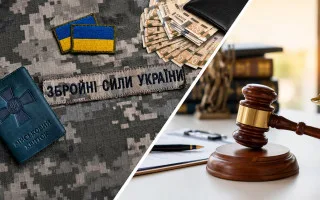
The Wife of the Deceased Soldier Registered Another Child Under His Name: The Soldier's Mother Challenged the Paternity Record in the Supreme Court.













Proofread version:
On 8 July 2026, the Supreme Court, in the composition of the panel of judges of the First Judicial Chamber of the Cassation Civil Court, considered case No. 383/817/24regarding the dispute over paternity after the death of the person recorded as the child’s father and the right of his mother to file a corresponding lawsuit.
The issue of protecting the rights of fallen servicemen and their families remains one of the most pressing in judicial practice. In this decision, the Supreme Court thoroughly explains the conditions under which the parents of the deceased may challenge his paternity.
Case circumstances
The plaintiff in the case was the mother of a serviceman who died while performing combat missions.
Her son was in a registered marriage with the defendant, but the couple had effectively ceased cohabitation back in 2019.
After the husband’s mobilisation to the Armed Forces of Ukraine and his subsequent death, the plaintiff learned that the defendant had given birth to a son, with her son recorded as the father in the birth record.
The plaintiff claimed that her son was not the biological father of this child and was unaware that he was recorded as the father.
During the case, a posthumous molecular genetic examination was appointed, but the defendant failed to appear with the child for biological sample collection without valid reasons, making it impossible to conduct the examination. At the same time, the defendant herself admitted in court that the deceased was not the biological father of her son.
Position of the Supreme Court
The Court noted that the European Court of Human Rights (ECHR) recognises the existence of family life considering both biological and factual family ties. There are cases where the presence of "family life" was established even without biological kinship, for example, when the absence of biological connection was established after prolonged factual contact between parents and children.
ECHR practice also indicates that the interests of the child can and should be considered only when signs of family life are established. In the absence of such criteria, the person disputing paternity has the right to appropriate protection of their rights.
The Supreme Court stated that if the person recorded as the father of the child died before the child’s birth, his heirs have the right to dispute his paternity, provided he submitted during his lifetime a statement to a notary denying his paternity (part one of Article 137 of the Family Code of Ukraine).
If the person recorded as the father died after filing a lawsuit to exclude his name as the father from the birth record, his heirs may support the claim in court (part two of Article 137 of the Family Code of Ukraine).
Part three of Article 137 of the Family Code of Ukraine provides that if, for valid reasons, a person was unaware of being recorded as the father of the child and died, their heirs: spouse, parents, and children, may dispute paternity.
The Supreme Court indicated that disputing paternity after the death of the person recorded as the father is possible if: he submitted a written denial of paternity before the child’s birth; filed a lawsuit during his lifetime to exclude the record of him as the father; or was unaware, for valid reasons, of being recorded as the father.
Thus, the law imperatively establishes that in this case, only the heirs of the person who, for valid reasons, was unaware of being recorded as the father and died, including the parents, have the right to dispute paternity.
The Supreme Court emphasised that under part three of Article 137 of the Family Code of Ukraine, it is not required to provide the court with evidence of inheritance acceptance by one of the parents, since according to part one of Article 1268 of the Civil Code of Ukraine, parents have priority inheritance rights by law.
The Court also noted that the subject of proof in a paternity dispute case is not the fact of inheritance but proving the absence of biological kinship with the child, as well as the unawareness of the person recorded as the father at the time of registration that he is not the biological father.
Therefore, the basis for excluding information about the father from the child’s birth record is any information confirming the child’s origin from a certain person, collected in accordance with the Civil Procedure Code of Ukraine.
Evaluating the circumstances established by the courts, the Supreme Court agreed with the appellate court’s conclusion that the child’s mother did not refute with proper and admissible evidence that the deceased man knew he was recorded as the father of the defendant’s son.
The Court took into account that after the child’s birth, the deceased did not live with the child’s mother and her son, which confirms the absence of grounds to conclude the existence of de facto family life between them.
Given the established absence of biological kinship between the deceased man and the child, the claims are subject to satisfaction.
Thus, the Supreme Court dismissed the cassation appeal and confirmed the legality of the appellate court’s decision to exclude information about the deceased man as the child’s father from the birth record.
The Court formed an important legal position according to which the parents of the deceased have the right to dispute his paternity if it is proven that he was unaware, for valid reasons, of being recorded as the father, and they do not need to prove inheritance acceptance to file a lawsuit.
Also read another position, where the Supreme Court decided that the court cannot refuse to dispute paternity due to the absence of DNA if it did not provide for the examination itself.
Subscribe to our Telegram channel t.me/sudua, follow SUD.UA on Google News , and join us on VIBER, WhatsApp, Facebook and on Instagram to stay informed about the important events.